Small-space storage fails for one reason: we buy containers before we measure the space they must fit. The bin is fine; the bin was never the problem. These seven ideas are ordered by how much real capacity they add per dollar, and every one of them starts with a measurement, not a purchase.
1. Claim the under-bed zone
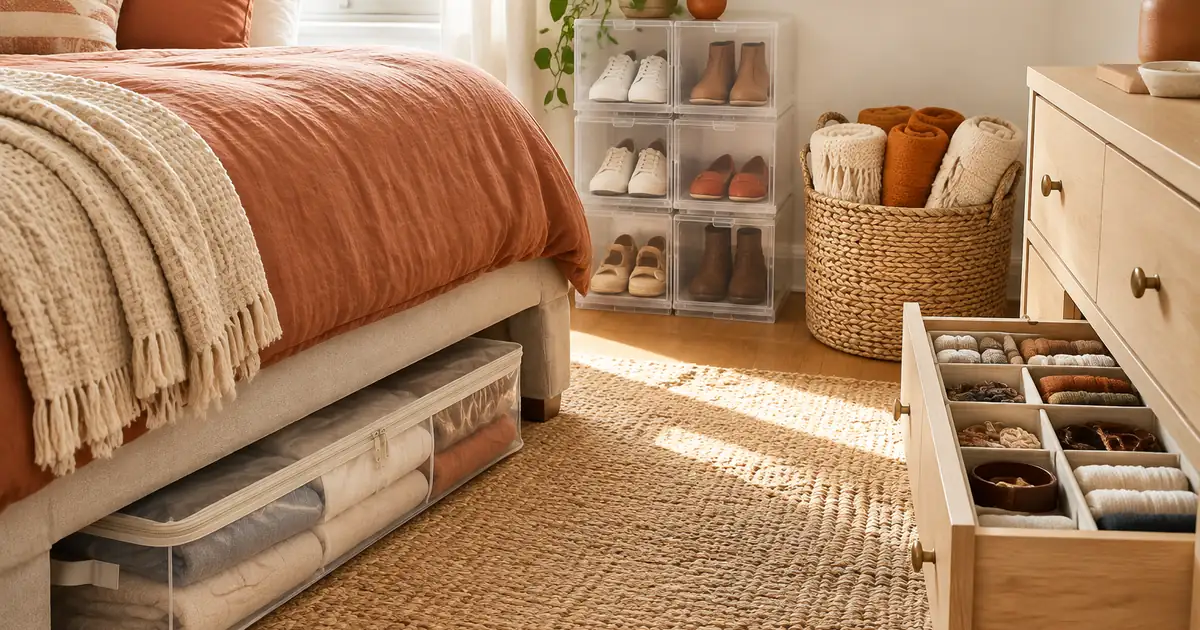
The space under a standard bed frame is the single largest unused volume in most apartments - roughly 40 by 70 by 6 inches. A clear 40-inch under-bed storage bag turns it into a seasonal closet: winter knits in January, extra bedding in July. Choose clear fronts over opaque ones; anything you cannot see is something you will buy twice.
2. Go vertical with stackable shoe boxes
Floor-level shoe piles waste the worst possible real estate - the first three feet of height, where shallow furniture could otherwise live. Modular stackable shoe organizers build upward instead, and because they are front-loading, you can wall them into a column two or three units high without unstacking the bottom row every morning.
3. Divide drawers once, benefit daily
Junk drawers are not a character flaw; they are a missing partition. Adjustable drawer dividers turn one chaotic drawer into four functional ones - batteries, chargers, tools, everything else. The rule that keeps them working: every section gets a category name in your head, and anything that has no section gets evicted, not stored.
4. Fold vertically, not flat
Borrowed from the Japanese folding method: store clothes folded so each item stands on edge like a file in a cabinet. You see every piece at once, and pulling one shirt does not collapse the stack. This single habit adds effective capacity to existing dressers - no product required, which is why it earns its place on a product-heavy list.
5. Use baskets as room-level sorting
A woven basket per zone - one for the living room blankets, one by the door for shoes and returns, one for cables - gives clutter a legal address. Baskets work where bins fail because they look intentional left out in the open, so you will actually leave them out, so clutter actually gets corralled.
6. Give the laundry a dedicated footprint
A hamper that only appears on laundry day migrates through the apartment collecting excuses. A foldable hamper that lives in one corner does the opposite: clothes go to the clothes place, and the bedroom floor stays a floor. Foldable matters in small spaces - on non-laundry days it collapses flat behind the door.
7. Audit the bathroom counter
Countertops are visual storage, and visual storage reads as mess even when it is tidy. A slim two-tier vanity organizer moves skincare and tools into a 12-inch footprint and returns your counter to empty. Everything you use daily stays reachable; everything else goes in the drawer you divided in idea three.
Store for the season, not for someday
The fastest way to double effective closet space costs nothing: date everything you store. A clear under-bed bag labeled with a season is a system; the same bag unlabeled is a landfill you pay rent on. If a stored item has not surfaced for two season rotations, it has left your life quietly - donate it without opening the bag. Storage professionals call this the rotation test, and it is the only decluttering method that requires zero willpower: the bag does the deciding for you while your daily life goes on untouched.
The 20-minute maintenance loop
Storage systems decay when maintenance is a project. Keep a 20-minute weekly loop: one basket emptied, one drawer re-divided, one under-bed bag re-sorted. Small and boring beats a yearly purge every time.
What not to buy
Three categories of storage product fail small apartments reliably. First, anything that promises to organize a space you have not emptied yet - sort first, size second. Second, single-purpose gadgets: an avocado holder and a lid spinner each solve one problem and create one more drawer. Third, matching container sets sold as a wall of ten; buy three of one size, live with them a month, then buy the size you actually reached for. The adjustable divider is the exception that proves the rule - it changes size with your drawer instead of forcing the drawer to change for it.
Start with the zone that annoys you most - for most renters that is shoes or the bathroom counter - and add the second system only after the first one has held for two weeks. Storage that arrives gradually sticks; storage that arrives all at once becomes its own clutter.