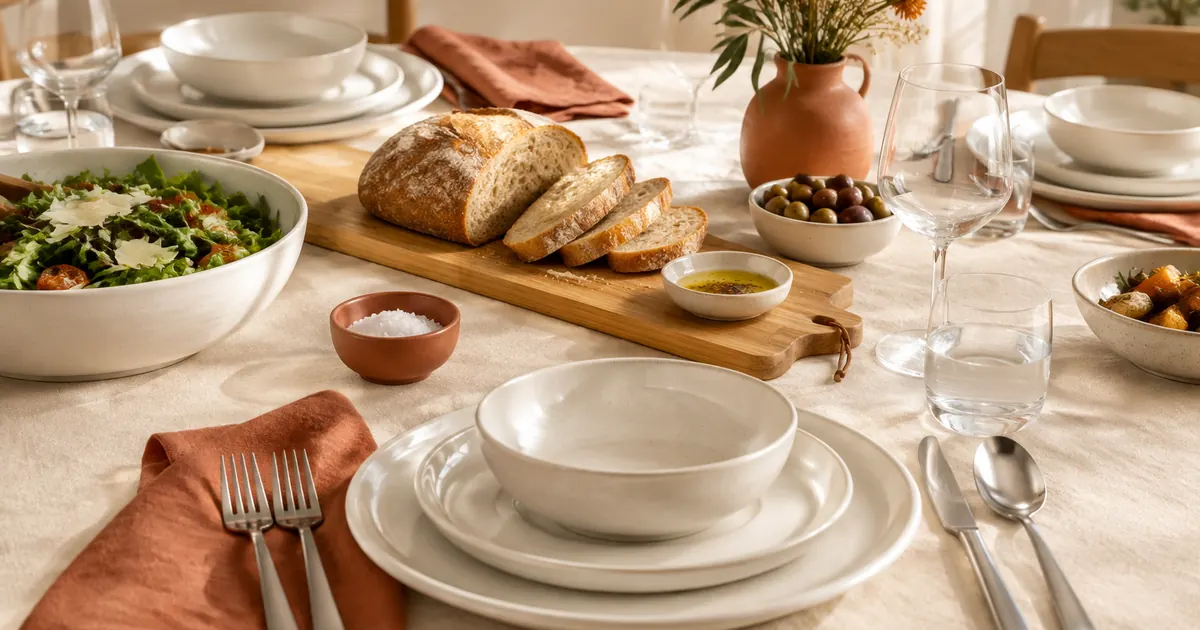
Most people buy dinnerware twice: once in a hurry when the old set breaks, and once again two years later when the hurried purchase chips, stains, or simply stops matching how they actually eat. A good everyday set is not the prettiest one on the shelf - it is the one that survives your dishwasher, your microwave, your children, and your cabinet space. Here is how to judge a set before you buy it, using the same five checks we apply when we select pieces for the Bazofino kitchen collection.
1. Start with the material, not the pattern
Everyday plates live in one of three materials. Stoneware is fired hot and feels substantial; it resists chipping better than cheap earthenware and keeps food warm longer. Porcelain is fired hotter still, so it is thinner, lighter, and more scratch-resistant - the tradeoff is a more delicate look and a higher price. Reactive-glaze ceramic gives you those beautiful hand-finished variations, but the glaze sits slightly softer, so it will show cutlery marks over time.
Our 16-piece minimalist ceramic dinnerware set sits in the stoneware camp on purpose: enough weight to feel grown-up at the table, enough glaze hardness to shrug off daily knife work.
2. Count the pieces you actually use
A 16-piece set sounds generous until you read the breakdown. The classic configuration is four each of dinner plates, salad plates, bowls, and mugs. Before buying, count your real week: if you host pasta night for six, four bowls means hand-washing mid-dinner. If nobody in your house drinks hot beverages, four mugs are cabinet clutter. It is usually smarter to buy a 16-piece core and add a second bowl set than to buy a 32-piece box where half of it never leaves the shelf.
The microwave test
Any set you use daily will meet your microwave. Metallic accents and certain glazes spark or scorch. If the listing does not explicitly say microwave safe, assume it is not - and remember that microwave safe means the body, not necessarily a metallic rim.
3. Check the dimensions against your cabinet
This is the check everyone skips. Standard dinner plates run 10 to 12 inches; a 12-inch plate does not fit shallow or older cabinets, and it will not sit flat in a standard plate rack. Measure your shelf depth and your dishwasher tines before you fall in love with an oversized rim. Salad plates at 7 to 8 inches nest under most dinner plates, which matters more than you think - nesting is free storage.
4. Weight is a feature
Heavier plates feel premium but punish you at the sink. If you wash dishes by hand or have kids who set the table, a plate in the 400 to 550 gram range is the sweet spot: solid enough to feel real, light enough that a stack of four is not a workout. Exact weights are rarely listed, so read reviews for the word heavy - it is the most common regret in dinnerware reviews, period.
5. Plan for chips before they happen
No everyday set is chip-proof, but two habits slow the process dramatically:
- Plate the sink, not the plate. Most chips happen when ceramic meets a hard sink bottom. A cheap rubber mat eliminates most first-year damage.
- Leave a paper-towel gap. Stacking plates directly against each other micro-scratches glaze. A folded towel between your two most-used stacks costs nothing.
What we would buy today
For a household of two to four: a 16-piece stoneware set in a light neutral, salad plates included, nothing with a metallic rim. Pair it with a three-piece bamboo board set for serving and a stainless utensil set, and your kitchen is functionally dressed for years - no seasonal replacements, no matching panic.
How to mix sets without matching
Matching everything is the fastest way to a dated table. The current approach is layered: one neutral everyday set, plus open-stock pieces in a related tone picked up over time. If you already own a white 16-piece set, a geometric ceramic vase in the same glaze family and a wood serving board do more for the table than a second boxed set ever will. The rule is one repeated element - same white, same wood, or same shape - repeated at least three times across the table. One lone accent piece reads as a mistake; three read as a decision.
Dinnerware is one of the few purchases you touch three times a day. Buy the boring, durable, well-proportioned version of it, and the pretty seasonal pieces become fun instead of essential.