No accessory punches above its price like a printed silk scarf. One 35-inch square delivers a neck tie, a bag accent, a hair ribbon, a wrist wrap, and a bag charm - five accessories that all pack flat and all cost the price of one. The trick is knowing the five knots well enough to reach for the right one without a mirror. Here they are, practiced on our 35-inch bohemian floral silk scarf.
1. The neck knot that never looks dated
Fold the scarf in half into a triangle, roll it from the long edge into a loose rope, then tie a single knot at the side of the neck with the ends forward. Side knots read softer than center knots and work with both collared shirts and crew necks. Keep the loop loose - a tight choke reads costume, a soft drape reads intentional.
2. The bag-handle tie
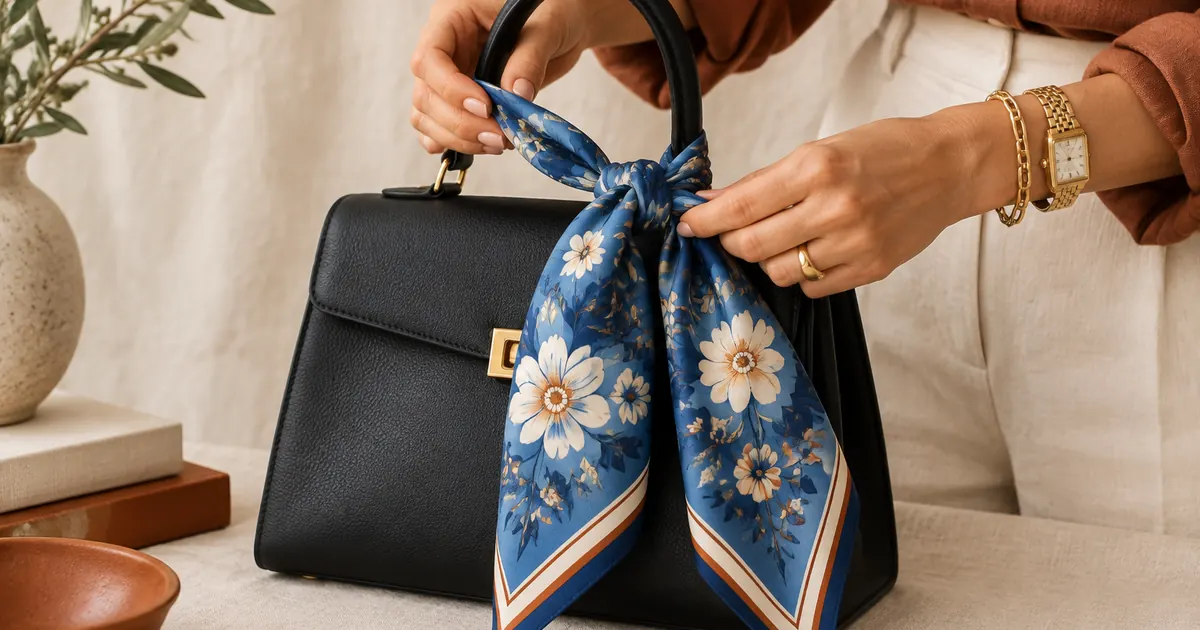
Thread the rolled scarf through a tote handle and tie one flat knot, leaving 6 to 8 inches of tail. This is the lowest-effort upgrade in fashion: it personalizes a plain work tote and protects the handle leather from hand oils at the same time. Match the scarf to something you are already wearing - a color from the print, not the loudest color in it.
3. The hair ribbon
Roll the scarf into a rope and tie it around a low ponytail or bun, ends trailing. On second-day hair this does double duty: it holds the style and hides the roots. Fine or slippery hair needs an anchor - tie the scarf around the elastic itself, not just the hair, or it will slide out by lunch.
4. The wrist wrap
Wrap the rolled scarf twice around the wrist and knot once. Worn with a watch, it reads as a bracelet stack; worn alone, it adds color to a sleeve-heavy outfit. This is also the most comfortable way to wear a scarf in summer - the silk breathes, and nothing sits against your neck in the heat.
5. The bag charm
Fold the square into a triangle, roll it, knot it through one handle ring, and let the ends fan. It is the same knot as the bag tie but placed on a ring or zipper pull instead of the handle. On a crossbody like our black faux leather crossbody, a printed scarf is the difference between a bag you carry and a bag you styled.
Choosing your first square
Size first, print second. Under 27 inches and the scarf can only be a bag tie; the full five looks in this guide need a 35-inch square, which is why that size became the industry standard. Weight matters more than silk percentage - a hand-rolled edge and a medium weight drape better than a thin, stiff weave at any price. On print direction, follow your wardrobe: if you live in neutrals, the scarf is your one loud piece and should be exactly that; if you already wear color, a two-tone print in your dominant shade ties the closet together. Our blue bohemian floral is the wardrobe-neutral pick precisely because blue is the one color almost every closet already owns.
Keeping silk looking new
Silk asks for three small habits:
- Hand-wash cool, skip the wring. Press water out in a towel, hang to dry away from sun. Sun is what fades prints, not washing.
- Iron the back side, medium heat. The face of the print stays slightly textured; the back takes the heat safely.
- Knot loosely in storage. Creases pressed in for months become permanent folds. A loosely rolled scarf stays smooth.
Two mistakes that date a scarf instantly
The first is the headscarf-as-headband wrapped tight across the forehead - a look that needs a very specific outfit to work and punishes every other one. Wear it behind the hairline instead, tied under the bun, and the same knot reads soft instead of costume. The second is over-matching: a scarf identical to the dress reads uniform, while a scarf two tones away from it reads styled. When in doubt, echo one color and contrast the rest. And if the scarf is a gift you are unsure about, the bag tie is the universally flattering default - it flatters the bag as much as the wearer.
One scarf, five looks, zero closet space. If you are buying your first printed square, pick a print with at least three colors you already wear - versatility comes from overlap with your existing wardrobe, not from the scarf alone. And when you find the knot you use most, that is the one worth practicing until it takes ten seconds.